SlideShare a Scribd company logo
DEVELOPMENT OF DENTITION
           &
       OCCLUSION


      INDIAN DENTAL ACADEMY
  Leader in continuing dental education


            www.indiandentalacademy.com
DEVELOPMENT OF TEETH:


•The embryonic oral cavity is lined by
stratified squamous epithelium- ORAL
ECTODERM

•Around 6th week of intra uterine life, the
infero-lateral border of the maxillary arch
& the supero-lateral border of the
mandibular arch show localized
proliferation of the oral ectoderm resulting
in the formation of a HORSE SHOE
SHAPED BAND of tissue called DENTAL
LAMINA.
   www.indiandentalacademy.com
•Deciduous teeth are formed by direct
proliferation of the dental lamina.
•The permanent teeth that replace the
primary teeth develop from its lingual
extension while the others develop from
its posterior extension called
SUCCESSIONAL LAMINA.


         www.indiandentalacademy.com
www.indiandentalacademy.com
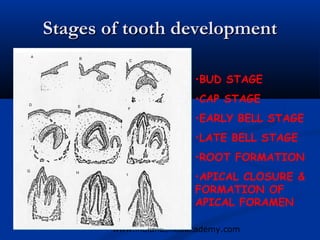
Stages of tooth development

                         •BUD STAGE
                         •CAP STAGE
                         •EARLY BELL STAGE
                         •LATE BELL STAGE
                         •ROOT FORMATION
                         •APICAL CLOSURE &
                         FORMATION OF
                         APICAL FORAMEN

        www.indiandentalacademy.com
The ectoderm in certain areas undergo proliferation to
form knob like projection that grow into the underlying
mesenchyme


which form the future ENAMAL ORGAN.
Ten such swellings are seen in each arch representing the
20 deciduous teeth


                    www.indiandentalacademy.com
Development of OCCLUSION

STAGES:
•GUM PAD STAGE
•DECIDIOUS DENTITION STAGE
•MIXED DENTATION STAGE
          FIRST TRANSITIONAL PERIOD
          INTER TRANSITIONAL PERIOD
          SECOND TRANSITIONAL PERIOD

•PERMANENT DENTATION STAGE
           www.indiandentalacademy.com
GUM PAD STAGE
•THIS IS THE PERIOD
AFTER BIRTH DURING
WHICH THE NEONATE
DOES NOT HAVE
ANY TEETH.
•IT USUALLY LASTS FOR 6
MONTHS AFTER BIRTH
•THE ALVEOLAR
PROCESSES AT THE TIME
OF BIRTH ARE KNOWN AS
GUM PADS.
•THEY ARE PINK, FIRM &
ARE COVERED BY A DENSE
LAYER OF FIBROUS
PERIOSTEUM.
               www.indiandentalacademy.com
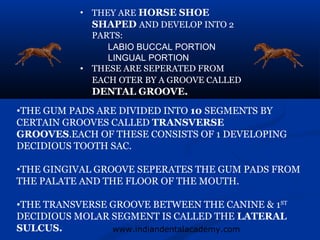
• THEY ARE HORSE SHOE
             SHAPED AND DEVELOP INTO 2
             PARTS:
                LABIO BUCCAL PORTION
                LINGUAL PORTION
           • THESE ARE SEPERATED FROM
             EACH OTER BY A GROOVE CALLED
             DENTAL GROOVE.
•THE GUM PADS ARE DIVIDED INTO 10 SEGMENTS BY
CERTAIN GROOVES CALLED TRANSVERSE
GROOVES.EACH OF THESE CONSISTS OF 1 DEVELOPING
DECIDIOUS TOOTH SAC.

•THE GINGIVAL GROOVE SEPERATES THE GUM PADS FROM
THE PALATE AND THE FLOOR OF THE MOUTH.

•THE TRANSVERSE GROOVE BETWEEN THE CANINE & 1ST
DECIDIOUS MOLAR SEGMENT IS CALLED THE LATERAL
SULCUS.         www.indiandentalacademy.com
•The upper & lower gum pads are
                  almost similar to each other .
                  •The upper gum pad is both wider
                  as well as longer than the
                  mandibular gum pad.

•When the upper and lower gum pads are
approximated there is a complete over jet all
around.
•Contact occurs between the upper and lower gum
pads in the 1st molar region & a space exists
between the anterior region.
•This infantile open bite is considered normal & it
helps in suckling.
                 www.indiandentalacademy.com
DECIDIOUS DENTATION
             STAGE
THE PRIMARY DENTATION STAGE EXTENDS FROM
ERUPTION OF THE PRIMARY TEETH UNTIL THE
ERUPTION OF 1ST PERMANENT TOOTH AROUND 6
YEARS OF AGE.

 CHARACTERSTICS OF
PRIMARY DENTATION:
    •OVER BITE
    •SPACING
    •MOLAR RELATION


                 www.indiandentalacademy.com
OVER BITE
• IT IS THE AMOUNT OF VERTICAL OVER LAP BETWEEN
  MAXILLARY AND MANDIBULAR CENTRAL INCISORS.
• DEEP BITE MAY BE SEEN IN THE INITIAL STAGES OF
  DEVELOPMENT.
• IT IS ASSENTUATED BY THE FACT THAT DECIDIOUS
  INCISORS ARE MORE UPRIGHT WITH THE LOWER
  INCISOR EDGES ALMOST CONTACTING THE UPPER
  CINGULUM.
• THIS DEEP BITE REDUCES LATER DUE TO:
     1. ERUPTION OF DECIDIOUS MOLARS
     2. ATTRITIION OF INCISORS
     3. FORWAD GROWTH OF MANDIBLE
     • In about 24% of the children open bite is noted due to
       various HABITS.
                   www.indiandentalacademy.com
SPACING

   IN A PRIMARY DENTATION STAGE A CHILD
    MAY HAVE GENERALISED SPACING; NO
    SPACING; LOCALISED SPACING OR CROWED
    DENTATION.

   GENERALISED SPACING OCCURS IN ALMOST
    2/3RD OF THE CHILDREN REFERED TO AS
    PHYSIOLOGICAL SPACES OR DEVELOPMENTAL
    SPACES

   LOCALISED SPACES LIKE PRIMATE SPACE ARE
    ALSO SEEN

               www.indiandentalacademy.com
PRIMATE SPACE
   ALSO CALLED SIMIAN SPACE
    OR ANTHROPOID SPACE
   SEEN IN ABOUT 87% CASES
   IN THE MAXILLARY ARCH IT IS
    PRESENT BETWEEN LATERAL
    AND CANINE.
   IN THE MANDIBULAR ARCH
    SEEN BETWEEN CANINE AND 1ST
    DECIDIOUS MOLAR.
   THIS SPACE IS USED UP BY THE
    DEVELOPING LARGER
    PERMANENT TEETH.

                 www.indiandentalacademy.com
NO SPACE


•NO SPACING BETWEEN THE PRIMARY
INCISORS GUARANTEES INSUFFICIEN ROOM
FOR THE PERMANENT INCISORS TO ERUPT
THUS RESULTING IN SEVERE CROWDING
REFERED TO AS   HOLLYWOOD SMILE.


            www.indiandentalacademy.com
Molar Relation
• In the primary dentition the molar relation is
  described in terms of TERMINAL PLANES.
• THE TERMINAL PLANES ARE THE DISTAL SURFACES
  OF THE 2ND PRIMARY MOLARS. THESE TWO
  TERMINAL PLANES CAN BE RELATED IN 3 WAYS:


1. FLUSH TERMINAL PLANE
2. MESIAL TERMINAL PLANE
3. DISTAL TERMINAL PLANE


                  www.indiandentalacademy.com
FLUSH TERMINAL PLANE:
                  BOTH MAXILLARY & MANDIBULAR PLANES ARE
                   AT THE SAME LEVEL ANTERIO-POSTERIORLY.


MESIAL STEP TERMINAL PLANE:
MAXILLARY TERMINAL PLANE IS RELATIVELY
MORE POSTERIOR THAN THE MANDIBULAR
TERMINAL PLANE FORMING A MESIAL STEP


                  DISTAL STEP TERMINAL PLANE:
                  THE MAXILLARY TERMINAL PLANE IS
                  RELATIVELY MORE ANTERIOR THAN THE
                  MANDIBULAR TERMINAL PLANE.
                    www.indiandentalacademy.com
ERUPTION SEQUENCE OF PRIMARY TEETH


           www.indiandentalacademy.com
MIXED DENTITION PERIOD
THIS STAGE STARTS WITH THE ERUPTION OF
THE PERMANENT 1ST MOLAR BY THE AGE OF 6
YEARS TO THE COMPLETION OF EXFOLIATION OF
ALL DECIDIOUS TEETH AT THE AGE OF 12-13
YEARS.


IN THE EARLY PART OF MIXED DENTITION
THERE MAY BE A TEMPORARY OPEN BITE USUALLY
DUE TO INCOMPLETE ERUPTION OF INCISORS OR
A PERSISTENT HABIT.

             www.indiandentalacademy.com
PHASES OF MIXED DENTITION
   FIRST TRANSITION PERIOD:
       EMERGENCE OF 1ST PERMANENT MOLAR
       INCISORS TRANSITION
       ESTABLISHMENT OF OCCLUSION
   INTER TRANSITION PERIOD
       BOTH SETS OF TEETH PRESENT
       4 PERMANENT INCISORS & 1ST PERMANENT MOLARS
        PRESENT
       DECIDIOUS CANINES AND 1ST & 2ND MOLARS
   SECOND TRANSITION PERIOD
       EMERGENCE OF BICUSPIDS, CUSPIDS,& SECOND
        PERMANENT MOLAR.
                  www.indiandentalacademy.com
        ESTABLISHMENT OF OCCLUSION
FIRST TRANSITIONAL PERIOD
      Emergence of 1st permanent molar:
ERUPTS BY AROUND 6TH YEAR OF LIFE
ITS LOCATION & RELATIONSHIP DEPENDS UPON THE
DISTAL SURFACE RELATIONSHIP BETWEEN UPPER AND
LOWER SECOND DECIDIOUS MOLARS.
THE DISTAL SURFACE OF THESE DECIDIOUS 2ND
MOLARS GUIDE THE ERUPTING PERMANENT MOLAR
INTO 3 RELATIONS:


                www.indiandentalacademy.com
10%


29%


42%

 www.indiandentalacademy.com
INCISAL LIABILITY
•THE UNERUPTED PERMANENT INCISORS ARE
LARGER THAN THE DECIDIOUS INCISORS.
•THIS IS REFERED TO AS INCISAL LIABILITY.


           ARCH           INCISAL
                         LIABILITY
           MAXILLA          7 mm
          MANDIBLE          5 mm


                www.indiandentalacademy.com
INCISAL LIABILITY IS OVERCOME BY THE
          FOLLOWING FACTORS:

1.   UTILIZATION OF INTERDENTAL SPACES
     SEEN IN PRIMARY DENTITION.
2.   INCREASE IN INTER-CANINE WIDTH
3.   CHANGE IN INCISOR INCLINATION


              www.indiandentalacademy.com
INTER-TRANSITIONAL PERIOD

   THIS IS A LATENT PERIOD WITH NO
    EXCHANGE OF TEETH TAKING PLACE.
   PERMANENT INCISORS AND 1ST MOLAR
    ARE PRESENT.
   DECIDIOUS CANINE, 1ST & 2ND MOLARS
    ARE PRESENT
   BY THE END OF THIS STAGE ALL THE
    TEETH ARE IN PROPER OCCLUSION.


              www.indiandentalacademy.com
SECOND TRANSITION PERIOD
   CHARACTERISED BY REPLACEMENT OF
    DECIDIOUS CANINES & MOLARS BY
    PREMOLARS AND PERMANENT CUSPIDS
    RESPECTIVELY.

   ERUPTION OF THE NON SUCCEDENOUS
    TEETH i.e., 2ND MOLARS.

   ESTABLISHMENT OF PROPER OCCLUSION


              www.indiandentalacademy.com
LEEWAY SPACE OF NANCE
       THE COMBINED MESIO DISTAL
       WIDTH OF THE PERMANENT CANINES
       AND PREMOLARS IS USUALLY LESS
       THAN THAT OF THE DECIDIOUS
       CANINES & MOLARS.

       THIS SURPLUS SPACE IS CALLED AS
       LEEWAY SPACE OF NANCE.
            ARCH            LEEWAY SPACE
       MAXILLARY         1.8 mm
                         (0.9 mm in each arch)

       MANDIBULAR        3.4 mm
                         (1.7 mm in each arch)
      www.indiandentalacademy.com
UGLY DUCKLING STAGE
  AS THE DEVELOPING PERMANENT CANINES ERUPT, THEY
DISPLACE THE ROOTS OF THE LATERAL INCISORS MESIALLY AND
INTURN ON TO THE CENTRAL INCISORS.
 THIS CAUSES THE FLARING UP OF THE INCISOR CROWNS.
 THUS CAUSING A MIDLINE DIASTEMA
 THIS SITUATION IS BEING DESCRIBED BY BROADBENT AS UGLY
DUCKLING STAGE.
 THIS OCCURS AROUND THE AGE OF 8-9 YEARS
 THIS CORRECTS BY ITSELF WHEN THE PERMANENT CANINE
ERUPTS COMPLETELY.


                    www.indiandentalacademy.com
www.indiandentalacademy.com
PERMANENT DENTITION STAGE
   ALL THE PERMANENT TEETH ARE FORMED
    AROUND BIRTH.

   THIS STAGE BEGINS WITH THE EXFOLIATION
    OF LAST PRIMARY TEETH AND ERUPTION OF
    ALL PERMANENT TEETH EXCEPT 3RD MOLAR.

   THE IMPORTANT CHARACTERSTICS OF NORMAL
    OCCLUSION IN PERMANENT DENTITION WERE:

   DESCRIBED BY ANDREW’S IN 1972 AS 6 KEYS OF
    OCCLUSION.


                www.indiandentalacademy.com
www.indiandentalacademy.com
ERUPTION SEQUENCE OF PERMANENT TEETH


            www.indiandentalacademy.com
ANDREW’S 6 KEYS OF OCCLUSION

                     KEY 1: MOLAR INTER ARCH
                     RELATIONSHIP


KEY 2: MESIO DISTAL CROWN
ANGULATION


            KEY 3: LABIO LINGUAL CROWN INCLINATION

                 www.indiandentalacademy.com
KEY 4: ABSENCE OF ROTATION


                             KEY 5: TIGHT CONTACTS


      KEY 6: CURVE OF SPEE


                www.indiandentalacademy.com
MOLAR RELATIONS
• PROPOSED BY E H ANGLE IN 1899
  DEPENDING ON 1ST MOLAR
  RELATIONSHIP FOR PERMANENT
  DENTITION


 CLASS 1
 CLASS 2   DIV 1
            DIV 2
 CLASS 3   TRUE
            PSEUDO
                www.indiandentalacademy.com
COMPENSATORY CURVES
   CURVE OF SPEE: ANTERIO POSTERIOR
   CURVE PASSING THROUGH THE BUCCAL
   CUSPS OF PREMOLARS AND MOLARS ON
   TO THE ANTERIOR BORDER OF RAMUS TO
   END ON THE CENTER OF CONDYLE.
   CURVE OF WILSON: IT IS A MEDIO
   LATERAL CURVE PASSING THROUGH
   BUCCAL TO PALATAL AND THEN PALATAL
   TO BACCAL OF THE OTHER SIDE.
   CURVE OF MONSON: IT IS A
   COMBINATION OF BOTH MEDIO LATERAL
   AND ANTERIOPOSTERIOR CURVE TO
   FORM A 8 INCH SPHERE WITH CENTER ON
   GLABELLA.
       www.indiandentalacademy.com
"Live as if you were to die
tomorrow.
 Learn as if you were to live
forever."
             -Mahatma Gandhi


                      THANK YOU


              INDIAN DENTAL ACADEMY
          Leader in continuing dental education
                     www.indiandentalacademy.com

More Related Content

PPTX
Contact & contour
PPTX
Introduction to orthodontics
PPTX
Morphology of human permanent dentition
PPTX
Occlusion
PPT
b- Types of tooth rests
DOC
PPT
Occlusal aspect of maxillary 2nd molar
Contact & contour
Introduction to orthodontics
Morphology of human permanent dentition
Occlusion
b- Types of tooth rests
Occlusal aspect of maxillary 2nd molar

What's hot (20)

PPT
PPTX
PPTX
growth and development of Mandible
PPTX
Anatomical landmarks of edentulous mandibular arch ppt (prosthodontics) easil...
PDF
Compensating Curves.pptx
PPT
Growth & development of mandible /fixed orthodontic courses
PPT
Mand. molars
PDF
Dental Pulp
PPTX
Development of maxilla and mandible copy
PPT
2.anatomy of the denture foundation areas
PPT
Mandibular Molars
PPT
PPTX
Normal development of occlusion part 1
PPTX
Prenatal influence on facial development
PPTX
Anatomical landmarks of mandibule
PPTX
Mandibular central & lateral incisors
PPTX
principles for restoration of badly broken teeth
PPT
Salivary glands /certified fixed orthodontic courses by Indian dental academy
PPT
Dentenogenesis and histology of dentin
growth and development of Mandible
Anatomical landmarks of edentulous mandibular arch ppt (prosthodontics) easil...
Compensating Curves.pptx
Growth & development of mandible /fixed orthodontic courses
Mand. molars
Dental Pulp
Development of maxilla and mandible copy
2.anatomy of the denture foundation areas
Mandibular Molars
Normal development of occlusion part 1
Prenatal influence on facial development
Anatomical landmarks of mandibule
Mandibular central & lateral incisors
principles for restoration of badly broken teeth
Salivary glands /certified fixed orthodontic courses by Indian dental academy
Dentenogenesis and histology of dentin
Ad

Viewers also liked (9)

PPT
Development of occlusion 1 /certified fixed orthodontic courses by Indian den...
PPT
Development of dentition & occlusion /certified fixed orthodontic courses by ...
PPTX
Development of occlusion AND dentition
PPTX
Development Of Dentition & Occlusion
PPTX
development of dentition and occlusion
PPTX
Development of the dentition
PDF
Development of Dentition and Occlusion _Dr. Nabil Al-Zubair
PPT
Development of dentition. /certified fixed orthodontic courses by Indian dent...
PPT
Development of dentition and occlusion
Development of occlusion 1 /certified fixed orthodontic courses by Indian den...
Development of dentition & occlusion /certified fixed orthodontic courses by ...
Development of occlusion AND dentition
Development Of Dentition & Occlusion
development of dentition and occlusion
Development of the dentition
Development of Dentition and Occlusion _Dr. Nabil Al-Zubair
Development of dentition. /certified fixed orthodontic courses by Indian dent...
Development of dentition and occlusion
Ad

Similar to Development of dentition & occlusion / /certified fixed orthodontic courses by Indian dental academy (20)

PPT
Development of dentition & occlusion in orthodontics /certified fixed orthodo...
PPT
Development of dentition & occlusion
PPT
Development of dentition & occlusion class (2)
PPT
Mixed dentition /certified fixed orthodontic courses by Indian dental academy
PPT
PPT
Development of occlusion 2 /certified fixed orthodontic courses by Indian den...
PPT
development of occlusion
PPTX
Development of occlusion
PPTX
Development of occlusion
PPTX
Developmensssssssssssssssssssssst of occlusion.pptx
PDF
occlusion.pdf
PPT
Clinical implications of growth
PPTX
DEVELOPMENT OF OCCLUSION IN PEDIATRIC DENTISTRY
PPT
Modified gum pads,devp of primary dentition
PPT
Development of dentition and occlusion
PPTX
 Development of occlusion
PPTX
Development of occlusion
PPT
DEVELOPMENT OF DENTITION & OCCLUSION. Spacing in mixed Dentition.ppt
PPTX
Postnatal growth
PPT
Development of primary dentition /certified fixed orthodontic courses by Indi...
Development of dentition & occlusion in orthodontics /certified fixed orthodo...
Development of dentition & occlusion
Development of dentition & occlusion class (2)
Mixed dentition /certified fixed orthodontic courses by Indian dental academy
Development of occlusion 2 /certified fixed orthodontic courses by Indian den...
development of occlusion
Development of occlusion
Developmensssssssssssssssssssssst of occlusion.pptx
occlusion.pdf
Clinical implications of growth
DEVELOPMENT OF OCCLUSION IN PEDIATRIC DENTISTRY
Modified gum pads,devp of primary dentition
Development of dentition and occlusion
 Development of occlusion
Development of occlusion
DEVELOPMENT OF DENTITION & OCCLUSION. Spacing in mixed Dentition.ppt
Postnatal growth
Development of primary dentition /certified fixed orthodontic courses by Indi...

More from Indian dental academy (20)

PPTX
Indian Dentist - relocate to united kingdom
PPT
1ST, 2ND AND 3RD ORDER BENDS IN STANDARD EDGEWISE APPLIANCE SYSTEM /Fixed ort...
PPT
Invisalign -invisible aligners course in india
PDF
Invisible aligners for your orthodontics pratice
PPTX
online fixed orthodontics course
PPTX
online orthodontics course
PPT
Development of muscles of mastication / dental implant courses
PPT
Corticosteriods uses in dentistry/ oral surgery courses  
PPT
Cytotoxicity of silicone materials used in maxillofacial prosthesis / dental ...
PPT
Diagnosis and treatment planning in completely endntulous arches/dental courses
PPT
Properties of Denture base materials /rotary endodontic courses
PPT
Use of modified tooth forms in complete denture occlusion / dental implant...
PPT
Dental luting cements / oral surgery courses  
PPT
Dental casting alloys/ oral surgery courses  
PPT
Dental casting investment materials/endodontic courses
PPT
Dental casting waxes/ oral surgery courses  
PPT
Dental ceramics/prosthodontic courses
PPT
Dental implant/ oral surgery courses  
PPT
Dental perspective/cosmetic dentistry courses
PPT
Dental tissues and their replacements/ oral surgery courses  
Indian Dentist - relocate to united kingdom
1ST, 2ND AND 3RD ORDER BENDS IN STANDARD EDGEWISE APPLIANCE SYSTEM /Fixed ort...
Invisalign -invisible aligners course in india
Invisible aligners for your orthodontics pratice
online fixed orthodontics course
online orthodontics course
Development of muscles of mastication / dental implant courses
Corticosteriods uses in dentistry/ oral surgery courses  
Cytotoxicity of silicone materials used in maxillofacial prosthesis / dental ...
Diagnosis and treatment planning in completely endntulous arches/dental courses
Properties of Denture base materials /rotary endodontic courses
Use of modified tooth forms in complete denture occlusion / dental implant...
Dental luting cements / oral surgery courses  
Dental casting alloys/ oral surgery courses  
Dental casting investment materials/endodontic courses
Dental casting waxes/ oral surgery courses  
Dental ceramics/prosthodontic courses
Dental implant/ oral surgery courses  
Dental perspective/cosmetic dentistry courses
Dental tissues and their replacements/ oral surgery courses  

Recently uploaded (20)

PDF
LDMMIA Reiki Yoga Finals Review Spring Summer
PDF
A systematic review of self-coping strategies used by university students to ...
PDF
1_English_Language_Set_2.pdf probationary
PDF
RTP_AR_KS1_Tutor's Guide_English [FOR REPRODUCTION].pdf
PPTX
Radiologic_Anatomy_of_the_Brachial_plexus [final].pptx
PPTX
Unit 4 Skeletal System.ppt.pptxopresentatiom
PDF
Chinmaya Tiranga quiz Grand Finale.pdf
PPTX
1st Inaugural Professorial Lecture held on 19th February 2020 (Governance and...
PPTX
Digestion and Absorption of Carbohydrates, Proteina and Fats
PPTX
History, Philosophy and sociology of education (1).pptx
PDF
Classroom Observation Tools for Teachers
PDF
LNK 2025 (2).pdf MWEHEHEHEHEHEHEHEHEHEHE
PPTX
Final Presentation General Medicine 03-08-2024.pptx
PDF
Empowerment Technology for Senior High School Guide
PDF
SOIL: Factor, Horizon, Process, Classification, Degradation, Conservation
PDF
OBE - B.A.(HON'S) IN INTERIOR ARCHITECTURE -Ar.MOHIUDDIN.pdf
PDF
Weekly quiz Compilation Jan -July 25.pdf
PDF
medical_surgical_nursing_10th_edition_ignatavicius_TEST_BANK_pdf.pdf
PPTX
Tissue processing ( HISTOPATHOLOGICAL TECHNIQUE
PDF
advance database management system book.pdf
LDMMIA Reiki Yoga Finals Review Spring Summer
A systematic review of self-coping strategies used by university students to ...
1_English_Language_Set_2.pdf probationary
RTP_AR_KS1_Tutor's Guide_English [FOR REPRODUCTION].pdf
Radiologic_Anatomy_of_the_Brachial_plexus [final].pptx
Unit 4 Skeletal System.ppt.pptxopresentatiom
Chinmaya Tiranga quiz Grand Finale.pdf
1st Inaugural Professorial Lecture held on 19th February 2020 (Governance and...
Digestion and Absorption of Carbohydrates, Proteina and Fats
History, Philosophy and sociology of education (1).pptx
Classroom Observation Tools for Teachers
LNK 2025 (2).pdf MWEHEHEHEHEHEHEHEHEHEHE
Final Presentation General Medicine 03-08-2024.pptx
Empowerment Technology for Senior High School Guide
SOIL: Factor, Horizon, Process, Classification, Degradation, Conservation
OBE - B.A.(HON'S) IN INTERIOR ARCHITECTURE -Ar.MOHIUDDIN.pdf
Weekly quiz Compilation Jan -July 25.pdf
medical_surgical_nursing_10th_edition_ignatavicius_TEST_BANK_pdf.pdf
Tissue processing ( HISTOPATHOLOGICAL TECHNIQUE
advance database management system book.pdf

Development of dentition & occlusion / /certified fixed orthodontic courses by Indian dental academy

  • 1. DEVELOPMENT OF DENTITION & OCCLUSION INDIAN DENTAL ACADEMY Leader in continuing dental education www.indiandentalacademy.com
  • 2. DEVELOPMENT OF TEETH: •The embryonic oral cavity is lined by stratified squamous epithelium- ORAL ECTODERM •Around 6th week of intra uterine life, the infero-lateral border of the maxillary arch & the supero-lateral border of the mandibular arch show localized proliferation of the oral ectoderm resulting in the formation of a HORSE SHOE SHAPED BAND of tissue called DENTAL LAMINA. www.indiandentalacademy.com
  • 3. •Deciduous teeth are formed by direct proliferation of the dental lamina. •The permanent teeth that replace the primary teeth develop from its lingual extension while the others develop from its posterior extension called SUCCESSIONAL LAMINA. www.indiandentalacademy.com
  • 5. Stages of tooth development •BUD STAGE •CAP STAGE •EARLY BELL STAGE •LATE BELL STAGE •ROOT FORMATION •APICAL CLOSURE & FORMATION OF APICAL FORAMEN www.indiandentalacademy.com
  • 6. The ectoderm in certain areas undergo proliferation to form knob like projection that grow into the underlying mesenchyme which form the future ENAMAL ORGAN. Ten such swellings are seen in each arch representing the 20 deciduous teeth www.indiandentalacademy.com
  • 7. Development of OCCLUSION STAGES: •GUM PAD STAGE •DECIDIOUS DENTITION STAGE •MIXED DENTATION STAGE FIRST TRANSITIONAL PERIOD INTER TRANSITIONAL PERIOD SECOND TRANSITIONAL PERIOD •PERMANENT DENTATION STAGE www.indiandentalacademy.com
  • 8. GUM PAD STAGE •THIS IS THE PERIOD AFTER BIRTH DURING WHICH THE NEONATE DOES NOT HAVE ANY TEETH. •IT USUALLY LASTS FOR 6 MONTHS AFTER BIRTH •THE ALVEOLAR PROCESSES AT THE TIME OF BIRTH ARE KNOWN AS GUM PADS. •THEY ARE PINK, FIRM & ARE COVERED BY A DENSE LAYER OF FIBROUS PERIOSTEUM. www.indiandentalacademy.com
  • 9. • THEY ARE HORSE SHOE SHAPED AND DEVELOP INTO 2 PARTS: LABIO BUCCAL PORTION LINGUAL PORTION • THESE ARE SEPERATED FROM EACH OTER BY A GROOVE CALLED DENTAL GROOVE. •THE GUM PADS ARE DIVIDED INTO 10 SEGMENTS BY CERTAIN GROOVES CALLED TRANSVERSE GROOVES.EACH OF THESE CONSISTS OF 1 DEVELOPING DECIDIOUS TOOTH SAC. •THE GINGIVAL GROOVE SEPERATES THE GUM PADS FROM THE PALATE AND THE FLOOR OF THE MOUTH. •THE TRANSVERSE GROOVE BETWEEN THE CANINE & 1ST DECIDIOUS MOLAR SEGMENT IS CALLED THE LATERAL SULCUS. www.indiandentalacademy.com
  • 10. •The upper & lower gum pads are almost similar to each other . •The upper gum pad is both wider as well as longer than the mandibular gum pad. •When the upper and lower gum pads are approximated there is a complete over jet all around. •Contact occurs between the upper and lower gum pads in the 1st molar region & a space exists between the anterior region. •This infantile open bite is considered normal & it helps in suckling. www.indiandentalacademy.com
  • 11. DECIDIOUS DENTATION STAGE THE PRIMARY DENTATION STAGE EXTENDS FROM ERUPTION OF THE PRIMARY TEETH UNTIL THE ERUPTION OF 1ST PERMANENT TOOTH AROUND 6 YEARS OF AGE. CHARACTERSTICS OF PRIMARY DENTATION: •OVER BITE •SPACING •MOLAR RELATION www.indiandentalacademy.com
  • 12. OVER BITE • IT IS THE AMOUNT OF VERTICAL OVER LAP BETWEEN MAXILLARY AND MANDIBULAR CENTRAL INCISORS. • DEEP BITE MAY BE SEEN IN THE INITIAL STAGES OF DEVELOPMENT. • IT IS ASSENTUATED BY THE FACT THAT DECIDIOUS INCISORS ARE MORE UPRIGHT WITH THE LOWER INCISOR EDGES ALMOST CONTACTING THE UPPER CINGULUM. • THIS DEEP BITE REDUCES LATER DUE TO: 1. ERUPTION OF DECIDIOUS MOLARS 2. ATTRITIION OF INCISORS 3. FORWAD GROWTH OF MANDIBLE • In about 24% of the children open bite is noted due to various HABITS. www.indiandentalacademy.com
  • 13. SPACING  IN A PRIMARY DENTATION STAGE A CHILD MAY HAVE GENERALISED SPACING; NO SPACING; LOCALISED SPACING OR CROWED DENTATION.  GENERALISED SPACING OCCURS IN ALMOST 2/3RD OF THE CHILDREN REFERED TO AS PHYSIOLOGICAL SPACES OR DEVELOPMENTAL SPACES  LOCALISED SPACES LIKE PRIMATE SPACE ARE ALSO SEEN www.indiandentalacademy.com
  • 14. PRIMATE SPACE  ALSO CALLED SIMIAN SPACE OR ANTHROPOID SPACE  SEEN IN ABOUT 87% CASES  IN THE MAXILLARY ARCH IT IS PRESENT BETWEEN LATERAL AND CANINE.  IN THE MANDIBULAR ARCH SEEN BETWEEN CANINE AND 1ST DECIDIOUS MOLAR.  THIS SPACE IS USED UP BY THE DEVELOPING LARGER PERMANENT TEETH. www.indiandentalacademy.com
  • 15. NO SPACE •NO SPACING BETWEEN THE PRIMARY INCISORS GUARANTEES INSUFFICIEN ROOM FOR THE PERMANENT INCISORS TO ERUPT THUS RESULTING IN SEVERE CROWDING REFERED TO AS HOLLYWOOD SMILE. www.indiandentalacademy.com
  • 16. Molar Relation • In the primary dentition the molar relation is described in terms of TERMINAL PLANES. • THE TERMINAL PLANES ARE THE DISTAL SURFACES OF THE 2ND PRIMARY MOLARS. THESE TWO TERMINAL PLANES CAN BE RELATED IN 3 WAYS: 1. FLUSH TERMINAL PLANE 2. MESIAL TERMINAL PLANE 3. DISTAL TERMINAL PLANE www.indiandentalacademy.com
  • 17. FLUSH TERMINAL PLANE: BOTH MAXILLARY & MANDIBULAR PLANES ARE AT THE SAME LEVEL ANTERIO-POSTERIORLY. MESIAL STEP TERMINAL PLANE: MAXILLARY TERMINAL PLANE IS RELATIVELY MORE POSTERIOR THAN THE MANDIBULAR TERMINAL PLANE FORMING A MESIAL STEP DISTAL STEP TERMINAL PLANE: THE MAXILLARY TERMINAL PLANE IS RELATIVELY MORE ANTERIOR THAN THE MANDIBULAR TERMINAL PLANE. www.indiandentalacademy.com
  • 18. ERUPTION SEQUENCE OF PRIMARY TEETH www.indiandentalacademy.com
  • 19. MIXED DENTITION PERIOD THIS STAGE STARTS WITH THE ERUPTION OF THE PERMANENT 1ST MOLAR BY THE AGE OF 6 YEARS TO THE COMPLETION OF EXFOLIATION OF ALL DECIDIOUS TEETH AT THE AGE OF 12-13 YEARS. IN THE EARLY PART OF MIXED DENTITION THERE MAY BE A TEMPORARY OPEN BITE USUALLY DUE TO INCOMPLETE ERUPTION OF INCISORS OR A PERSISTENT HABIT. www.indiandentalacademy.com
  • 20. PHASES OF MIXED DENTITION  FIRST TRANSITION PERIOD:  EMERGENCE OF 1ST PERMANENT MOLAR  INCISORS TRANSITION  ESTABLISHMENT OF OCCLUSION  INTER TRANSITION PERIOD  BOTH SETS OF TEETH PRESENT  4 PERMANENT INCISORS & 1ST PERMANENT MOLARS PRESENT  DECIDIOUS CANINES AND 1ST & 2ND MOLARS  SECOND TRANSITION PERIOD  EMERGENCE OF BICUSPIDS, CUSPIDS,& SECOND PERMANENT MOLAR.  www.indiandentalacademy.com ESTABLISHMENT OF OCCLUSION
  • 21. FIRST TRANSITIONAL PERIOD Emergence of 1st permanent molar: ERUPTS BY AROUND 6TH YEAR OF LIFE ITS LOCATION & RELATIONSHIP DEPENDS UPON THE DISTAL SURFACE RELATIONSHIP BETWEEN UPPER AND LOWER SECOND DECIDIOUS MOLARS. THE DISTAL SURFACE OF THESE DECIDIOUS 2ND MOLARS GUIDE THE ERUPTING PERMANENT MOLAR INTO 3 RELATIONS: www.indiandentalacademy.com
  • 23. INCISAL LIABILITY •THE UNERUPTED PERMANENT INCISORS ARE LARGER THAN THE DECIDIOUS INCISORS. •THIS IS REFERED TO AS INCISAL LIABILITY. ARCH INCISAL LIABILITY MAXILLA 7 mm MANDIBLE 5 mm www.indiandentalacademy.com
  • 24. INCISAL LIABILITY IS OVERCOME BY THE FOLLOWING FACTORS: 1. UTILIZATION OF INTERDENTAL SPACES SEEN IN PRIMARY DENTITION. 2. INCREASE IN INTER-CANINE WIDTH 3. CHANGE IN INCISOR INCLINATION www.indiandentalacademy.com
  • 25. INTER-TRANSITIONAL PERIOD  THIS IS A LATENT PERIOD WITH NO EXCHANGE OF TEETH TAKING PLACE.  PERMANENT INCISORS AND 1ST MOLAR ARE PRESENT.  DECIDIOUS CANINE, 1ST & 2ND MOLARS ARE PRESENT  BY THE END OF THIS STAGE ALL THE TEETH ARE IN PROPER OCCLUSION. www.indiandentalacademy.com
  • 26. SECOND TRANSITION PERIOD  CHARACTERISED BY REPLACEMENT OF DECIDIOUS CANINES & MOLARS BY PREMOLARS AND PERMANENT CUSPIDS RESPECTIVELY.  ERUPTION OF THE NON SUCCEDENOUS TEETH i.e., 2ND MOLARS.  ESTABLISHMENT OF PROPER OCCLUSION www.indiandentalacademy.com
  • 27. LEEWAY SPACE OF NANCE THE COMBINED MESIO DISTAL WIDTH OF THE PERMANENT CANINES AND PREMOLARS IS USUALLY LESS THAN THAT OF THE DECIDIOUS CANINES & MOLARS. THIS SURPLUS SPACE IS CALLED AS LEEWAY SPACE OF NANCE. ARCH LEEWAY SPACE MAXILLARY 1.8 mm (0.9 mm in each arch) MANDIBULAR 3.4 mm (1.7 mm in each arch) www.indiandentalacademy.com
  • 28. UGLY DUCKLING STAGE AS THE DEVELOPING PERMANENT CANINES ERUPT, THEY DISPLACE THE ROOTS OF THE LATERAL INCISORS MESIALLY AND INTURN ON TO THE CENTRAL INCISORS. THIS CAUSES THE FLARING UP OF THE INCISOR CROWNS. THUS CAUSING A MIDLINE DIASTEMA THIS SITUATION IS BEING DESCRIBED BY BROADBENT AS UGLY DUCKLING STAGE. THIS OCCURS AROUND THE AGE OF 8-9 YEARS THIS CORRECTS BY ITSELF WHEN THE PERMANENT CANINE ERUPTS COMPLETELY. www.indiandentalacademy.com
  • 30. PERMANENT DENTITION STAGE  ALL THE PERMANENT TEETH ARE FORMED AROUND BIRTH.  THIS STAGE BEGINS WITH THE EXFOLIATION OF LAST PRIMARY TEETH AND ERUPTION OF ALL PERMANENT TEETH EXCEPT 3RD MOLAR.  THE IMPORTANT CHARACTERSTICS OF NORMAL OCCLUSION IN PERMANENT DENTITION WERE:  DESCRIBED BY ANDREW’S IN 1972 AS 6 KEYS OF OCCLUSION. www.indiandentalacademy.com
  • 32. ERUPTION SEQUENCE OF PERMANENT TEETH www.indiandentalacademy.com
  • 33. ANDREW’S 6 KEYS OF OCCLUSION KEY 1: MOLAR INTER ARCH RELATIONSHIP KEY 2: MESIO DISTAL CROWN ANGULATION KEY 3: LABIO LINGUAL CROWN INCLINATION www.indiandentalacademy.com
  • 34. KEY 4: ABSENCE OF ROTATION KEY 5: TIGHT CONTACTS KEY 6: CURVE OF SPEE www.indiandentalacademy.com
  • 35. MOLAR RELATIONS • PROPOSED BY E H ANGLE IN 1899 DEPENDING ON 1ST MOLAR RELATIONSHIP FOR PERMANENT DENTITION  CLASS 1  CLASS 2 DIV 1 DIV 2  CLASS 3 TRUE PSEUDO www.indiandentalacademy.com
  • 36. COMPENSATORY CURVES CURVE OF SPEE: ANTERIO POSTERIOR CURVE PASSING THROUGH THE BUCCAL CUSPS OF PREMOLARS AND MOLARS ON TO THE ANTERIOR BORDER OF RAMUS TO END ON THE CENTER OF CONDYLE. CURVE OF WILSON: IT IS A MEDIO LATERAL CURVE PASSING THROUGH BUCCAL TO PALATAL AND THEN PALATAL TO BACCAL OF THE OTHER SIDE. CURVE OF MONSON: IT IS A COMBINATION OF BOTH MEDIO LATERAL AND ANTERIOPOSTERIOR CURVE TO FORM A 8 INCH SPHERE WITH CENTER ON GLABELLA. www.indiandentalacademy.com
  • 37. "Live as if you were to die tomorrow. Learn as if you were to live forever." -Mahatma Gandhi THANK YOU INDIAN DENTAL ACADEMY Leader in continuing dental education www.indiandentalacademy.com